
The Buyer-Ready Path — Build Beliefs Before the Call
Prospects don't book because they haven't resolved the beliefs that make booking feel safe. Here's the four-belief sequence that fills a calendar with qualified calls.

There is a version of content marketing that produces a lot of attention and almost no calls. Practitioners running this version spend serious time and money producing content — posts, videos, emails, maybe a podcast — watch their audience grow or their follower count tick up, and then wonder why the calendar stays empty.
The content is not the problem. The problem is a missing understanding of what content is actually for and what has to happen in a prospect's mind before they book a call.
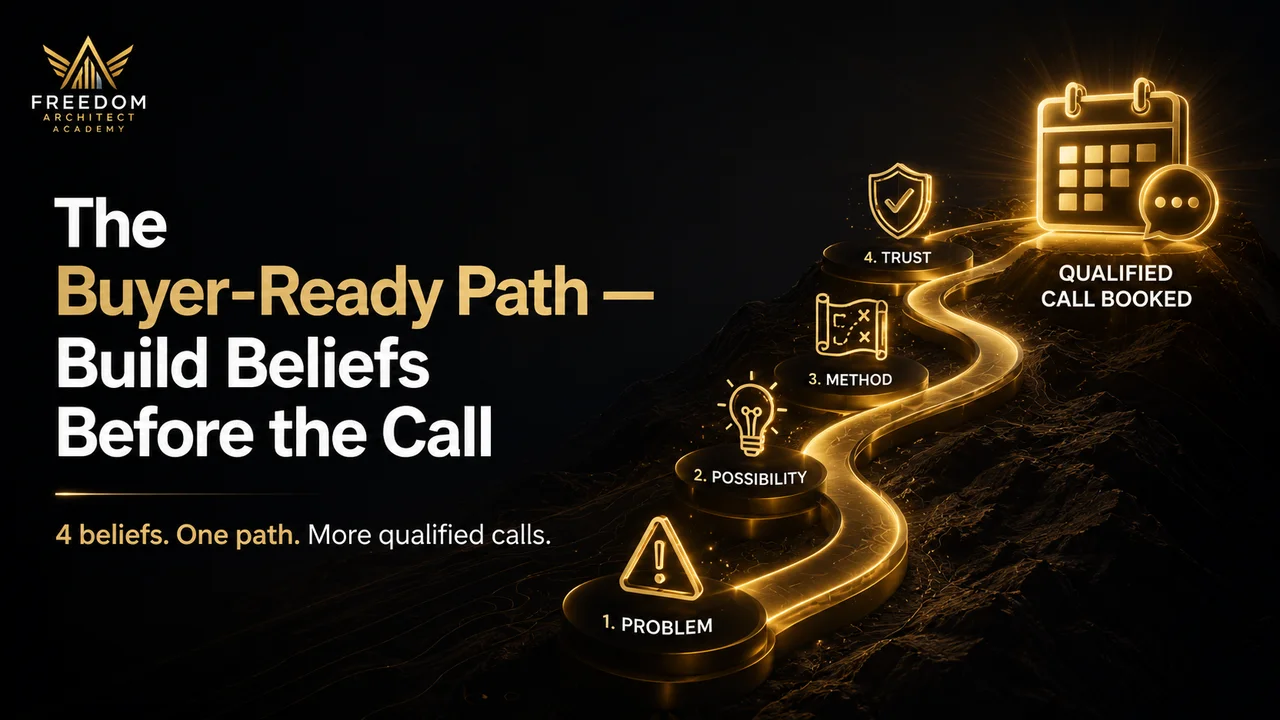
Content does not book calls. Beliefs book calls. Specifically, four of them — and your content, your funnel, your VSL, and your follow-up are all most valuable when they are organized around building those four beliefs in sequence. When they are not, you get engagement without conversion. When they are, you get a calendar of people who are already sold on the method before they ever speak to you.
This is the buyer-ready path.
TL;DR
- Prospects who don't book are not disinterested — they have unresolved beliefs that make booking feel premature or unsafe.
- There are four beliefs every prospect needs before they book a strategy call with confidence.
- Belief one: My problem is real, expensive, and worth solving.
- Belief two: A solution exists and is accessible to me.
- Belief three: This expert's method works.
- Belief four: This expert can help me specifically.
- Your entire content and funnel strategy should be organized around building these beliefs in sequence.
Contents
- Why content alone does not fill your calendar
- The four beliefs a prospect needs before booking
- Belief one: The problem is real and expensive
- Belief two: A solution exists
- Belief three: This method works
- Belief four: You can help me specifically
- How to build the path deliberately
- FAQ
Why content alone does not fill your calendar
Most experts who produce content think about it as a visibility strategy: the more you post, the more people know you exist, the more leads you get. There is something to this, but it is incomplete in a way that costs most practitioners real money.
Visibility without belief-building is like a storefront without a salesperson. People walk by, notice the display, maybe follow the account — and then move on. They are not opposed. They are not wrong to move on. They simply have not been given what they need to take the next step.
What they need is not more content. It is the right content in the right sequence, designed to answer the specific questions that stand between their current position and the moment they feel ready to have a real conversation.
The buyer-ready path is that sequence made explicit. When you understand which beliefs are missing for your specific prospect, and you organize your content and funnel around building those beliefs one at a time, two things change: your content becomes more targeted and effective, and your calls shift from being exploratory to being confirmatory — the prospect shows up already convinced, already qualifying themselves, already oriented toward yes.
The four beliefs a prospect needs before booking
The human decision to book a call with an expert involves trusting several things at once: that the problem is real, that a solution exists, that this particular method works, and that this particular expert can help them. Break down that trust at any point and the call does not happen — even if the prospect genuinely wants the outcome you offer.
Four beliefs, in order. Each one is a prerequisite for the next. You cannot build belief three before belief two is in place. You cannot build belief four before beliefs one through three are solid.
Belief one: The problem is real and expensive
Before a prospect can take you seriously, they have to take their own problem seriously.
This sounds obvious. It is not. Many people who have an expensive problem have partially normalized it — they know things aren't right, but they have been living with the situation long enough that they've adjusted their expectations. The problem feels like a fact of life rather than a solvable condition.
Your job in the first layer of the buyer-ready path is to name the problem more precisely than the prospect has been naming it for themselves. When you can describe their situation — the specific frustration, the specific ceiling, the specific gap between where they are and where they know they should be — more accurately than they've been able to describe it, something shifts. The problem becomes real in a new way. The cost becomes visible. The urgency increases.
This is the work of positioning and the Blueprint stage: naming the specific expensive problem so precisely that the right person reads it and thinks, "This is exactly what I'm dealing with." Content that does this does not need to hard-sell the service. The clarity about the problem does the work.
Posts that name a specific, expensive problem — the expertise trap, the income ceiling, the feast-or-famine cycle — are doing belief-one work. They make the problem real for the right person.
Belief two: A solution exists
Once the problem is real and urgent, the prospect needs to believe that a solution exists — that this is not simply the price of doing business as an expert, that others have solved it, and that it is solvable for someone like them.
This belief is undermined by the most common failure mode in expert content: describing the problem very well and then offering nothing but empathy. The prospect reads it, feels understood, and then goes back to their life unchanged because there is no throughline to resolution.
Belief-two content offers that throughline. It shows that the problem has a solution — not by pitching the service, but by showing the solved version. Case logic (what the situation looks like when it's resolved), principle explanations (why the solution works), and process previews (here's the shape of how this gets fixed) all do belief-two work.
This is why the free training is structured the way it is: it teaches real methodology, not a teaser for the paid program. The experience of watching it and feeling genuine progress on the problem — seeing how it could resolve, even if only partially — produces belief two and three simultaneously. The prospect leaves the training believing a solution exists and that this method is the vehicle.
Belief three: This method works
Belief three is where specific credibility is established — not generic credibility ("I'm an expert"), but methodological credibility: this specific approach to this specific problem has worked, and there is a coherent reason why it works.
The credibility that produces this belief is not primarily testimonials and credentials, though those are helpful signals. It is the quality of the thinking itself. An expert who can explain their process with enough clarity and specificity that the prospect can see how each step would apply to their own situation is generating belief three with every substantive piece of content they produce.
This is one of the reasons cornerstone content matters. A post that walks through a method in real depth — not just naming the stages but explaining the logic of why each stage comes when it does, what it produces, and what it enables — does far more belief-three work than a dozen posts that name-drop results without showing mechanism. The Freedom Architecture Method post is designed to do exactly this: demonstrate the method's coherence so that the prospect can evaluate it, not just accept it on faith.
Belief four: You can help me specifically
The last belief is the most personal: not just that a solution exists and the method works, but that this expert can help this specific person with their specific situation.
This is where generic positioning fails. "I help consultants grow their business" doesn't activate belief four, because it applies to thousands of people and says nothing about whether the expert understands the prospect's specific circumstances. The prospect is not asking whether you have helped consultants in general. They are asking whether you have helped someone who looks like them, with a problem like theirs, starting where they are.
Specificity is the mechanism. Specific descriptions of who you help, specific examples of what that looks like, specific articulation of the expensive problems your buyers face — these details make the right prospect feel seen. When they feel seen, belief four becomes almost automatic: of course you can help me specifically, because you understand my situation better than most people I've told it to in person.
Stop chasing clients and build a system that speaks directly to the specific person you serve — not the broadest possible market. Belief-four content is precise by design.
How to build the path deliberately
The buyer-ready path is not a natural result of producing content consistently. It requires intentional design.
Here is what that design looks like in practice:
Audit your existing content for which beliefs it builds. Most experts who look at their content library find it is heavily weighted toward belief one (naming the problem) and very light on beliefs three and four (method credibility, specific fit). That's where the conversion gap lives.
Design your funnel around the belief sequence. The content-to-call pipeline is not just a traffic mechanism — it is a belief-building sequence. The opt-in page should activate belief one and start belief two. The free training should complete beliefs two and three and begin belief four. The booking page should reinforce belief four: here is exactly who this is for, here is the application process, here is what the next step looks like.
Use follow-up to complete the sequence for stragglers. Many prospects opt in and watch the training but don't book immediately — not because they're disinterested, but because one of the four beliefs is not yet solid enough. An email follow-up sequence designed around the belief gaps (FAQ-style content, specific-case examples, method explanations, profile-matching language) fills those gaps over time and brings more prospects to the point where booking feels like the obvious next step.
Write cornerstone content for each belief. A belief-one cornerstone is a deep post on the specific expensive problem. A belief-two cornerstone shows the resolution path. A belief-three cornerstone explains the method in depth. A belief-four cornerstone is highly specific about who is a fit and who is not. Four cornerstones, one per belief, creates the backbone of a content strategy that reliably moves prospects toward qualified calls.
The Accelerate stage of the method is where this path is activated — getting traffic into the top, ensuring the sequence is working, and iterating based on real conversion data. If you want to see how the full path is built and what each element looks like in practice, the free training walks through the complete sequence.
FAQ
How long does it take for a prospect to go from first contact to booking?
It varies significantly. Some prospects opt in and book within hours, having already built the necessary beliefs from prior content exposure. Others take weeks or months of follow-up. The average across a well-built funnel is typically 7 to 21 days between first opt-in and booked call, with meaningful conversion continuing beyond 90 days for prospects who took longer to build the later beliefs.
What if my content is good but the calls are low quality?
Low-quality calls usually mean belief four is not being built effectively. If prospects show up without understanding specifically who you work with and what the engagement looks like, they may have beliefs one through three but not four. Sharpen the qualification layer: the booking page application questions, the pre-call email sequence, and the specificity of your "who it's for" content. The goal is that only well-qualified prospects make it to the calendar.
Does every piece of content need to address all four beliefs?
No. Individual pieces work best when they focus on one belief deeply rather than trying to build all four at once. The portfolio of content across the buyer-ready path covers all four; each piece does its specific job. The funnel sequence, however, should be designed to move a prospect through all four in the right order — which is why the free training is typically where beliefs two, three, and four are built most efficiently.
Can I build the buyer-ready path without paid advertising?
Yes. Paid advertising accelerates the process by putting the top of the path in front of more people faster, but the path itself works regardless of traffic source. Organic content, partnerships, speaking engagements, and referrals can all drive qualified prospects into the sequence. The belief-building mechanism is the same; only the speed and volume of incoming traffic differs.
What breaks the buyer-ready path most often?
The most common break is between beliefs two and three: the prospect believes a solution exists in theory but does not yet believe this specific method will work. This usually means the free training or content does not go deep enough into the mechanism. A prospect who watches a training and walks away knowing you said the right things but not understanding how the approach actually works has not built belief three. The fix is more depth, more specificity, and more mechanism explanation — not more social proof.
Ready to put this into action?
The free training shows you the entire Expertise Engine — the fastest way to turn ideas like these into a premium business.
Want help applying this to your own expertise-based business? Join the free Freedom Architect Academy community.