
The Content-to-Call Pipeline — Attention to Calls
Views and likes don't pay the bills — booked calls do. Here's the simple pipeline that turns attention you already earn into qualified calls.

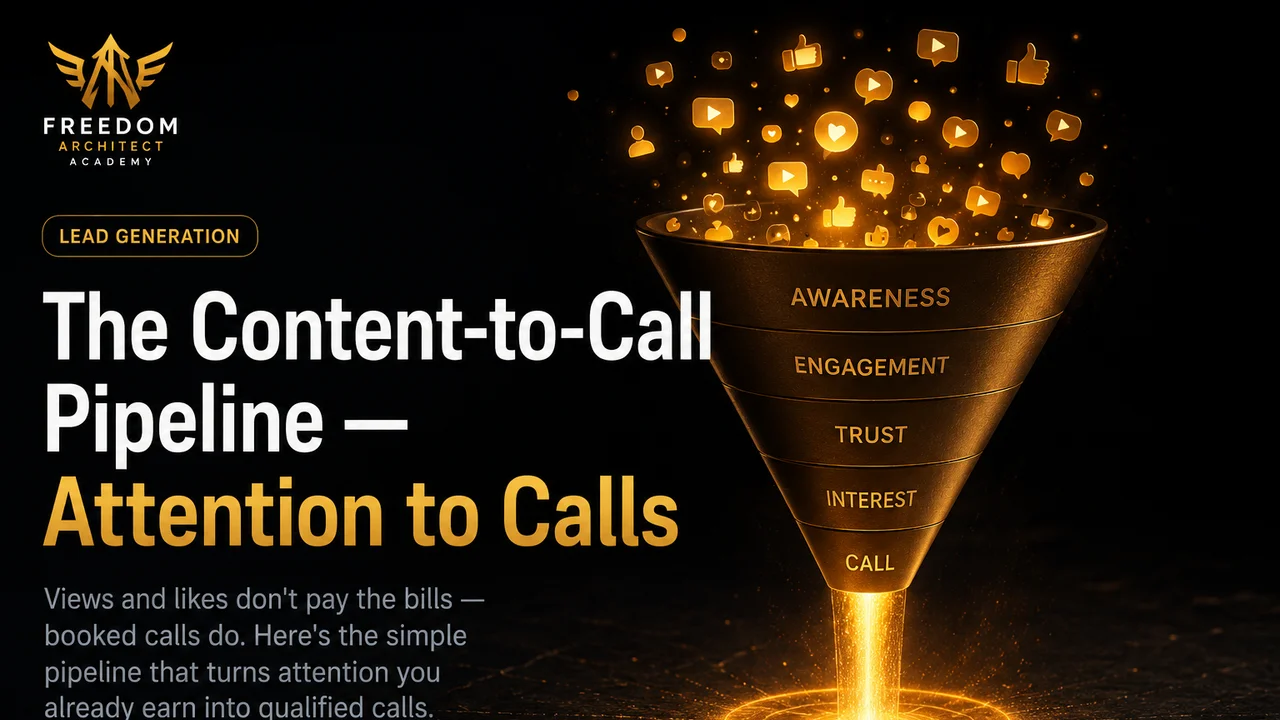
Most experts treat lead generation like a slot machine. Post something, hope it lands, refresh the metrics. When a piece does well, they celebrate the views. When it flops, they blame the algorithm. And through all of it, the calendar stays empty.
The problem isn't the content. It's that there's no pipeline behind it. Attention is flowing in and then leaking straight back out, because nothing is built to catch it and move it forward.
TL;DR
- Attention is raw material, not the goal — a view is not a lead and a like is not a buyer.
- A working pipeline has three jobs: earn attention, capture the interested, convert the qualified.
- Stage one is content that selects the right person and repels the wrong one.
- Stage two is a low-friction next step that delivers a small win before asking for a call.
- Stage three is a call for closing, not convincing, because the pipeline pre-qualifies people.
Contents
- Attention is the raw material, not the goal
- Stage one: content that selects, not just attracts
- Stage two: a next step that does not feel like a sales trap
- Stage three: the call is for closing, not convincing
- Build the pipe before you pour in more water
- FAQ
Attention is the raw material, not the goal
A view is not a lead. A like is not a buyer. They're signals that someone paused long enough to notice you. That's valuable, but only if you have a system to convert that pause into a next step.
Think of it as a pipeline with three jobs:
- Earn the attention with content that speaks to a specific problem.
- Capture the interested by giving them a clear, low-friction next step.
- Convert the qualified into a booked call where the real conversation happens.
Skip any stage and the whole thing leaks. Great content with no capture is a leak. A great offer with no qualified calls is a leak. The money is in connecting the stages, not in perfecting any single one.

Stage one: content that selects, not just attracts
The mistake is writing content to be liked. You want content that selects — that makes the right person lean in and the wrong person scroll past. This is going to market doing real work, not vanity reach.
- Name the problem out loud. When you describe someone's exact frustration better than they can, they assume you have the solution.
- Pick a side. Vague, agreeable content gets ignored. A clear point of view earns trust because it signals you actually know something.
- Speak to one person. Content written for "everyone" lands with no one. Write to the single buyer you most want to work with.
AI shortens the gap between knowing your buyer deeply and publishing content that proves it — the AI Expertise Engine makes that leverage concrete.
Stage two: a next step that does not feel like a sales trap
Once someone is interested, give them somewhere to go that feels safe. Not "book a call" the instant they meet you — that's asking for marriage on a first date. Offer a piece of genuine value first: a free training, a guide, a breakdown. Something that delivers a small win and earns the right to ask for more.
This is where the email or the opt-in matters. It moves the relationship off a platform you don't control and onto a channel you do. If you're still doing this by hand, that's the trap behind chasing clients instead of building a system.
Stage three: the call is for closing, not convincing
By the time someone books a call, the selling should already be done. A good pipeline pre-qualifies people through the content and the free value, so the people who reach your calendar already trust you, already understand the offer, and are mostly deciding whether it's right for them — the moment you actually close the sale.
That's the difference between a call that feels like pulling teeth and one where the prospect is half-sold before they say hello.
Build the pipe before you pour in more water
If your calls are empty, the answer is almost never "make more content." It's "build the pipeline that catches the content you're already making."
The pipeline works because it's organized around the buyer-ready path — the four beliefs a prospect needs to hold before a call feels like the right next step. These three stages map directly to the Build, Automate, and Accelerate phases of the Freedom Architecture Method — where the full content-to-call infrastructure gets its architecture. The Accelerate stage is where that pipeline finally meets buyers at volume and the calendar starts to fill. The free training walks through exactly how to assemble this pipeline.
FAQ
Why are my posts getting views but no clients?
Because views aren't a pipeline. Without a clear next step to capture interested people and a call flow to convert them, attention leaks straight back out. Add the capture and conversion stages and the same content starts producing calls.
What should the "next step" actually be?
A low-friction offer that delivers a small, real win — a free training, a guide, or a breakdown — in exchange for an email or opt-in. It should feel like value, not a sales trap, and it should move the relationship onto a channel you control.
Should I ask people to book a call right away?
Usually not. Jumping straight to "book a call" asks for too much trust too soon. Lead with genuine value first so that by the time someone books, they already trust you and understand the offer.
Do I need a big following to make this work?
No. A small, well-qualified pipeline outperforms a large, leaky one. The goal isn't more attention — it's catching and converting the attention you already earn.
Ready to put this into action?
The free training shows you the entire Expertise Engine — the fastest way to turn ideas like these into a premium business.
Want help applying this to your own expertise-based business? Join the free Freedom Architect Academy community.