
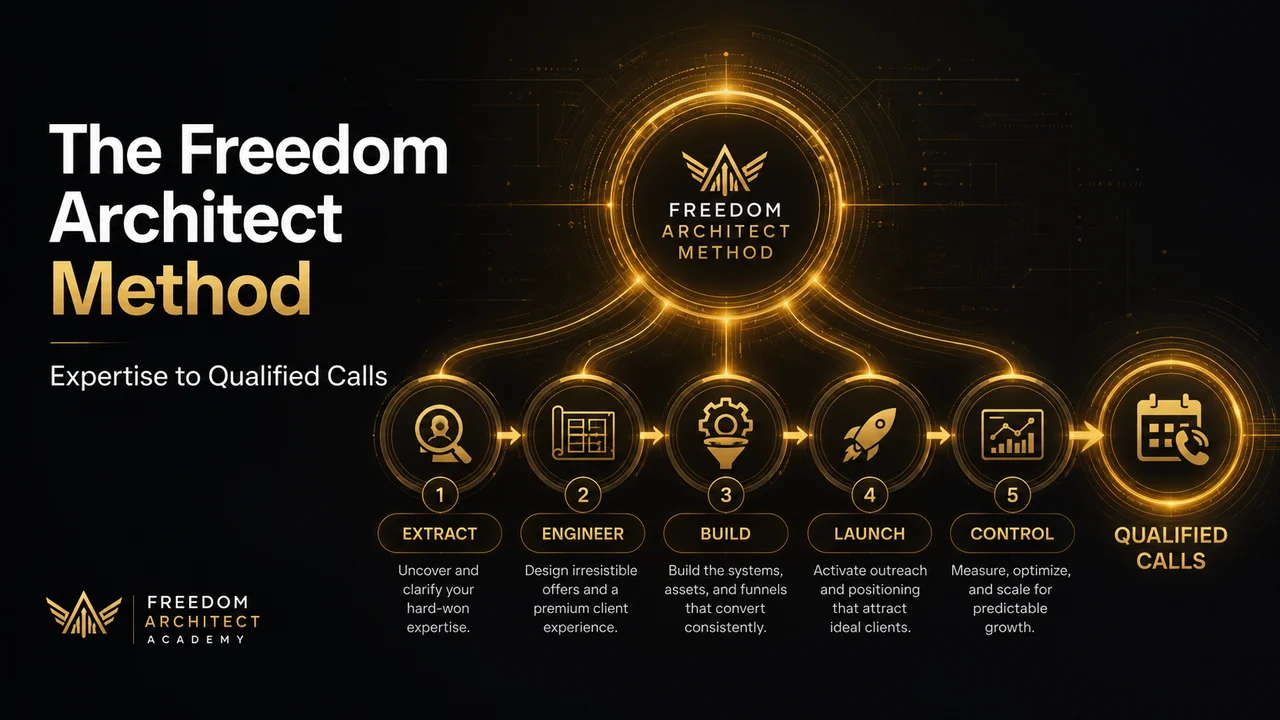
The Freedom Architecture Method — Expertise to Qualified Calls
Five sequential stages — Blueprint, Build, Automate, Accelerate, Optimize — that turn a high-ticket offer into a complete client acquisition system with qualified calls.

Most experts who struggle to turn their knowledge into a freedom business have the same problem: they are great at the doing, and they often already have an offer — but they are stuck on the system that should be selling it for them.
They can solve the problem — they've done it dozens of times. Many of them even have a high-ticket offer, or a clear direction for one. What they don't have is the machine: the funnel, the CRM, the follow-up, and the automation that consistently puts that offer in front of the right buyers and books qualified calls without constant outreach. So they stay stuck: highly skilled, intermittently busy, dependent on referrals and luck.
The Freedom Architecture Method exists to fix exactly that. It is five sequential stages — Blueprint, Build, Automate, Accelerate, and Optimize — that take you from a high-ticket offer to a complete client acquisition system with a repeatable flow of qualified strategy calls. Not a philosophy. Not a motivational framework. A working sequence with a specific output at each stage.
TL;DR
- The Freedom Architecture Method is five stages: Blueprint, Build, Automate, Accelerate, Optimize.
- They run in sequence because each stage creates what the next one needs.
- Blueprint maps the system: the offer, the buyer, the promise, and the full architecture.
- Build installs the assets — funnel pages, free training or VSL, CRM, calendar, and delivery.
- Automate wires the follow-up, AI nurture, and pipeline so the system runs without you.
- Accelerate drives traffic into the system and fills the calendar with qualified calls.
- Optimize tracks what's working and compounds it — this is where the Three Freedoms become real.
Contents
- Why most experts never build a real business
- Stage one: Blueprint
- Stage two: Build
- Stage three: Automate
- Stage four: Accelerate
- Stage five: Optimize
- How the five stages compound
- FAQ
Why most experts never build a real business
The pattern is almost universal. Someone spends a decade — sometimes two — getting genuinely good at something. They know the craft better than most. They have real results to point to, and often a premium offer they already sell. And yet the business side stays fragile: client-dependent, referral-reliant, calendar-constrained.
The reason is not lack of effort. It's lack of system.
Most experts try to build out of order, or never build at all. They post content with no funnel underneath it. They collect leads with no CRM to hold them. They book the occasional call but have no follow-up catching the ones who go quiet. Every individual move makes some intuitive sense, but without an architecture connecting them, the effort leaks away.
The Freedom Architecture Method imposes the right sequence. Each stage produces a specific output, and that output is the required input for the next stage. Skip ahead, and you're building on sand. Follow the sequence, and each investment compounds into the next.
Stage one: Blueprint
What happens: You map the system before you build any of it.
Most experts waste months building the wrong thing in the wrong order. Blueprint fixes that. Before touching a single page or tool, you lock the foundation and design the architecture everything else will follow.
This stage has three outputs:
-
The locked offer and promise. If you already have a high-ticket offer, Blueprint sharpens it — the specific outcome, the buyer, and the price that holds up. If you only have a direction, Blueprint commits it to a single, sellable promise.
-
The specific buyer and message. Not a demographic. The person who feels the problem most urgently, has budget, and has tried to solve it before. The narrower the definition, the more that person feels seen — and the words that make them feel seen become the message that runs through every page.
-
The system architecture. The offer-to-operating-system architecture: which funnel pages, what CRM and pipeline, which follow-up and automation — mapped end to end so the build is execution, not guesswork.
Most experts leave this stage seeing their business clearly for the first time. The expertise trap is the belief that skill alone determines income — Blueprint is where you replace that with a concrete plan for the system that will actually sell what you know.
Stage two: Build
What happens: You build the assets the blueprint specified.
This is the stage most experts skip entirely — or try to fake with a basic website and a hope that word-of-mouth keeps going. It doesn't hold.
The Build stage installs the funnel system — the working assets a prospect actually moves through:
- The free training or VSL path. A short video (30–60 minutes) that teaches real value while demonstrating your method. The primary purpose is belief-building, not information transfer.
- The funnel pages. The opt-in page, the watch page, the application and booking page. Designed around the buyer-ready path — the specific sequence of beliefs a prospect must hold before they book.
- The CRM and pipeline. Where leads go after they opt in. Without a CRM, leads leak. A pipeline tracks where every prospect is and what the next action is.
- The calendar and booking flow. The calendar flow that gets a qualified prospect booked, confirmed, and showing up.
- Delivery infrastructure. The structure for actually running the engagements once calls are booked and clients are in.
The Build stage is what separates a real business from a freelancing arrangement: built once, it runs repeatedly.
Stage three: Automate
What happens: You wire the system so it runs and follows up without your daily attention.
Most leads don't convert on the first touch — they convert through consistent follow-up. The problem is that manual follow-up is exactly what busy experts drop. Automate closes that gap.
This stage installs the leverage layer:
- Follow-up sequences. Automated email and SMS automation that nurtures every lead from opt-in to booked call without manual outreach.
- AI follow-up. AI follow-up that answers questions and re-engages quiet leads fast, in your voice, around the clock — powered by an AI business brain trained on your offer and method.
- Show-rate and no-show recovery. A show-rate system of confirmations and reminders, plus no-show recovery that rebooks the prospects who miss their call instead of losing them.
- Pipeline automation. Stage changes inside the CRM that trigger the right action automatically, so nothing falls through the cracks as volume grows.
Automation is the difference between a business that depends on your constant attention and one that delivers booked calls while you sleep. For the full breakdown of what this stage installs — the CRM, the nurture sequences, AI follow-up, and no-show recovery — read the Automate stage in depth.
Stage four: Accelerate
What happens: You drive traffic into the finished system and fill the calendar.
With the system built and the automation running, Accelerate is about feeding the machine and scaling what works — not polishing further.
The Accelerate stage typically involves:
- Activating the traffic source. Paid advertising, organic content, partnerships, or direct outreach — whatever channel fits the business model and budget.
- Filling the calendar. Driving qualified prospects through the funnel so the content-to-call pipeline produces a steady stream of booked strategy sessions.
- Testing the message. Real market feedback — opt-in rates, show rates, objections on calls — is what sharpens the message against actual buyers.
- Scaling what converts. Once a channel and message produce booked, qualified calls profitably, you increase spend and reach deliberately rather than guessing.
Accelerate is where the client acquisition system starts compounding: more traffic into a system that already converts means more clients without more manual work. For the full breakdown of choosing a traffic source, reading the numbers, and scaling what converts, read the Accelerate stage in depth.
Stage five: Optimize
What happens: You track what's working, fix what isn't, and compound the business over time.
Optimize is not a maintenance stage. It is the stage where the business becomes genuinely free — where the Three Freedoms (location, financial, time) become real rather than aspirational.
This stage has three dimensions:
-
Optimization. Weekly tracking of the numbers that matter: opt-in rate, show rate, call-close rate, cost per booked call, average contract value. Find the weakest link and fix it on purpose. What you measure, you can improve.
-
Systematization. Every process that is still in your head becomes a documented, automated system. Client onboarding, delivery, off-boarding, referral capture. The more systematized, the less you're needed for every decision.
-
Scaling. With a working system, you can scale deliberately: increase traffic budget, add team, expand the offer suite, or simply protect the income and time you've built. The Optimize stage is where you transition from "operator" to "architect."
The freedom side of the method — location freedom first, then financial freedom, then time freedom — becomes available in this stage. Not all at once. In sequence. Which is the only way it works.
How the five stages compound
Each stage creates the necessary conditions for the next. Blueprint without Build produces a plan but no system. Build without Automate produces a system that still needs you to run it. Automate without Accelerate produces a machine with no fuel. Accelerate without Optimize produces revenue with no leverage.
The power is in the sequence because each output compounds. A clear architecture (Blueprint) produces a coherent system (Build). A coherent system produces hands-free follow-up (Automate). Hands-free follow-up produces more calls per dollar of traffic (Accelerate). More calls with tracking produces better optimization (Optimize). And better optimization produces more freedom.
This is not a program for people who want to get a little better at freelancing. It is a system for building a real business around what you already know. If you want to see the full method in action — how the stages connect and what the output looks like at each one — the free training walks through it from start to finish.
FAQ
Who is the Freedom Architecture Method for?
It is for experts who already have a high-ticket offer — or a clear direction for one — and are stuck on the system that should be selling it: consultants, coaches, agency owners, and service providers who know their craft but don't have the funnel, CRM, follow-up, and automation around it. It is not for beginners building skills; it is for people who already have the expertise and need the client acquisition system around it.
How long does it take to go through all five stages?
Timeline depends on starting point and effort invested. Most people working with the method seriously can complete Blueprint and Build within the first 30 days, layer in Automate and begin Accelerate by day 30–60, and start booking qualified calls in that window. Optimize is ongoing. For committed members with a high-ticket offer already in hand, getting a working system to that point is a realistic implementation outcome — not a fixed program guarantee, but an achievable result with consistent effort.
Do I need to complete each stage before moving to the next?
Yes, in substance if not always in name. The stages are sequential because each one's output is the next one's required input. You cannot automate a system that isn't built, and you cannot build one without a blueprint of who it's for and how it connects. The most common source of wasted effort in expert businesses is running stages out of order.
What makes this different from a business course or coaching program?
The method is a sequenced operating system, not a curriculum. It produces specific outputs at each stage — a mapped architecture, a built system, working automation, live traffic, and measurable results — rather than teaching concepts and leaving implementation to you. The distinction matters because experts usually don't need more information. They need the right sequence of actions and a system that holds the work together.
Can I build this while still doing client work?
Yes. Most people who go through the method do it alongside existing client commitments. Blueprint can be done in focused working sessions. Build and Automate are the most time-intensive stages, but the system is built once and runs repeatedly. The goal is to build the engine while keeping the income, then shift into Accelerate and Optimize as the engine begins producing its own revenue.
Ready to put this into action?
The free training shows you the entire Expertise Engine — the fastest way to turn ideas like these into a premium business.
Want help applying this to your own expertise-based business? Join the free Freedom Architect Academy community.