
The AI Expertise Engine — Knowledge Into Content, Calls, Clients
AI does not replace expert knowledge. It multiplies it — turning one person's expertise into a content, lead generation, and sales machine that runs continuously.

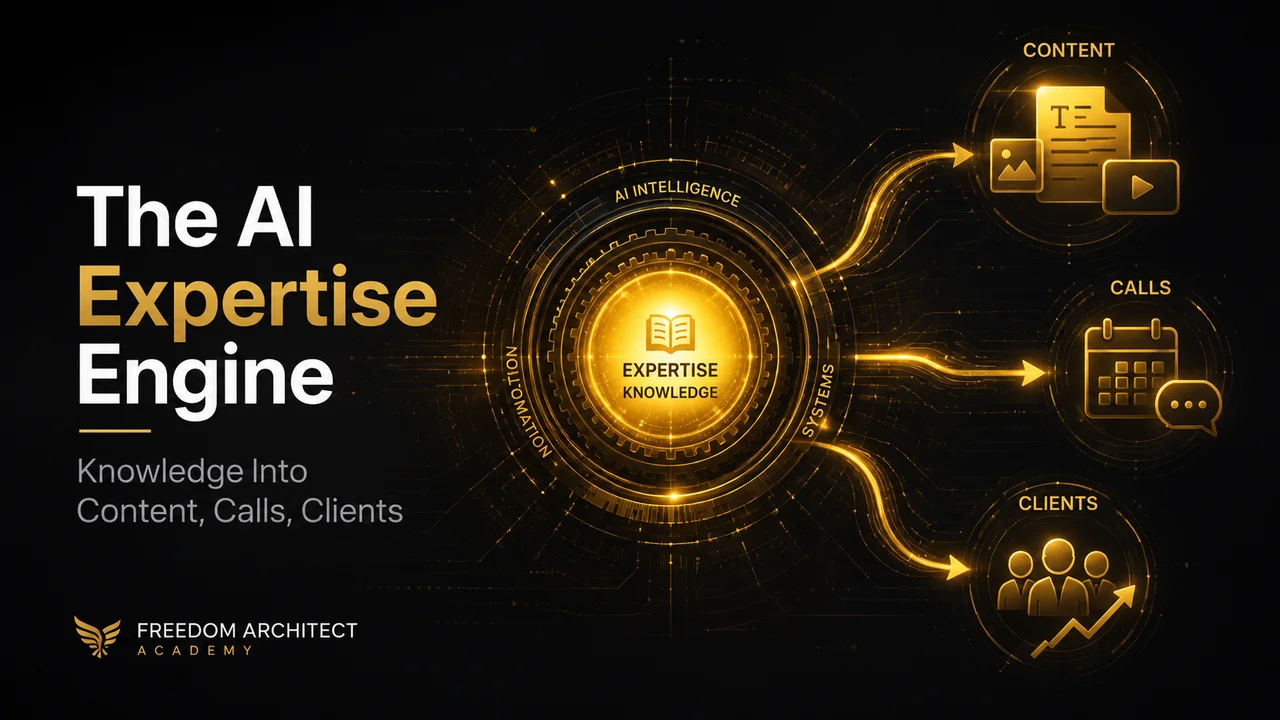
There is a version of the AI conversation that is genuinely useful and a version that is largely noise. The noise version is about prompts, chatbots, and whether AI will replace your job. The useful version is about leverage: how a single expert, using AI well, can now produce the content, systems, and follow-up that used to require a marketing team — and do it in a fraction of the time, without burning out.
The leverage gap between experts who understand this and those who don't is widening fast. Not because AI replaces expertise — it doesn't and can't — but because expertise combined with AI infrastructure produces output that expertise alone never could.
The AI Expertise Engine is not a product or a software platform. It is the operating model that results when you complete the Freedom Architecture Method: an infrastructure of content, attraction, sales, and delivery systems — all powered by your specific expertise, with AI doing the heavy lifting around it.
TL;DR
- AI does not replace your expertise; it multiplies what your expertise can produce in a given amount of time.
- The AI Expertise Engine is the output of the Build stage of the method — a set of interconnected systems that turns your knowledge into content, leads, calls, and clients.
- It has four components: the content engine, the attraction system, the sales process, and the delivery leverage layer.
- Experts who build this infrastructure can generate qualified conversations without manual outreach, nurture leads without writing individual emails, and serve clients without trading hours for every dollar.
- The expertise is still the input. Without genuine knowledge, there is nothing for the engine to amplify.
Contents
- The leverage gap
- What the AI Expertise Engine actually is
- Component one: The content engine
- Component two: The attraction system
- Component three: The sales process
- Component four: Delivery leverage
- Why expertise is still the input
- FAQ
The leverage gap
In any market with working experts, there has always been a gap between the ones who produce great client work and the ones who also build great client pipelines. The skills required for each are different, and most experts are strong at one and weak at the other.
AI does not close that gap automatically. But it changes what is possible on the pipeline side without requiring the expert to become a full-time marketer.
Before AI assistance, building a real content and lead generation machine required either a substantial personal time investment (writing weekly, posting daily, building email sequences by hand) or a marketing team — both expensive options that most solo experts and small consulting firms couldn't sustain.
With AI assistance, that equation changes. A single expert can now produce:
- A library of content that would have taken months, built in weeks
- Email sequences and follow-up systems that nurture leads without manual writing
- VSL scripts and ad creative tested and refined faster than any previous generation could
- Delivery frameworks, client communication templates, and SOPs that compress the time required to serve clients at scale
The leverage gap between AI-enabled experts and non-enabled experts is not subtle. It compounds over time. And the experts who close that gap earliest will have a structural advantage that is genuinely hard to reverse.
What the AI Expertise Engine actually is
The AI Expertise Engine is the infrastructure that sits between your expertise and your income.
Without it, the path from "someone who has valuable knowledge" to "someone who consistently earns premium fees for that knowledge" requires a direct, labor-intensive connection. You personally write the content. You personally follow up with leads. You personally nurture the prospect through the sales process. You personally build every client deliverable from scratch.
With it, your expertise flows through systems. You invest the thinking once — into the content, the training, the follow-up sequences, the delivery frameworks — and those investments keep working without requiring your ongoing attention. The engine runs between your expertise and your income.
It has four components, and the Build stage of the method is where they are installed.
Component one: The content engine
The content engine is how your expertise gets distributed at scale.
For most experts, content is a manual, sporadic, and inconsistent process: write something when inspired, post when you have time, repeat irregularly until burnout. That approach produces activity but rarely produces authority — because authority is built through consistent, high-quality presence over time, not occasional brilliant insights.
An AI-assisted content engine changes the dynamic. The expert's job shifts from "produce content" to "provide the thinking." A deep-dive conversation about your perspective on a specific problem, recorded or transcribed, becomes the raw material. AI systems then help structure, draft, repurpose, and distribute that thinking across formats — long-form posts, short-form hooks, email content, ad creative.
The output is not generic AI-generated content. It is your expertise, your perspective, your real examples and frameworks — compressed, organized, and distributed with much less of your manual effort. One piece of substantive thinking can become a long-form post, a series of short-form social posts, three email segments, and a VSL chapter.
The content engine does not replace the need for genuine expertise. It amplifies the distribution of the expertise you already have.
Component two: The attraction system
The attraction system is how interested people find you, raise their hand, and enter your pipeline.
For experts without this, client acquisition happens through referrals, word of mouth, or cold outreach — all of which are deeply manual and fundamentally unpredictable. The content engine produces distribution, but distribution alone does not produce leads. You need a mechanism that converts attention into a concrete next step.
The attraction system is that mechanism. It has three layers:
The lead magnet or free training. Something of genuine value that a prospective buyer can access in exchange for their contact information. For most expertise-based businesses, this is a video training or VSL that teaches a real concept from the method while demonstrating the expert's depth. The goal is not to give everything away — it is to produce a real shift in the prospect's thinking, so that they leave understanding both the problem more clearly and the expert more credibly.
The funnel. The sequence of pages and steps that move a prospect from "I found this interesting" to "I want to talk." Opt-in, watch, book. Each page has a specific job, and each one is built around the buyer-ready path — the sequence of beliefs a prospect needs to have before they are ready to book a strategy call.
The traffic source. Whatever channel brings the right people to the top of the funnel. Paid advertising, organic content distribution, partnerships, direct outreach into specific communities. The channel matters less than the targeting — getting the message in front of people who already have the expensive problem the offer solves.
AI assists at every layer: ad creative, landing page copy, VSL scripts, A/B test variations. What used to take a copywriter weeks takes an AI-enabled expert days.
Component three: The sales process
The sales process is how interested prospects become paying clients.
Most experts either have no formal sales process (they wing it on every call) or a process they resent (they feel like they're doing "salesy" things that conflict with their identity). Both produce worse results than a clear, structured conversation that is genuinely in the service of the right person.
The Freedom Architect approach to sales is built around one question: is this person a genuine fit for what we do? The strategy call is a diagnostic, not a pitch. The expert's job is to understand the prospect's situation with precision, assess whether the offer is the right solution, and make a clear recommendation.
AI assists in this process in two specific ways:
Pre-call preparation. When a prospect fills out an application form, AI can summarize their situation, flag the most relevant elements, and prepare the expert to have an informed conversation from the first minute. Instead of spending the first ten minutes of a call getting oriented, the expert arrives already knowing the context.
Post-call follow-up. The majority of closed engagements are not decided on the first call. Follow-up — timely, relevant, personalized — is what closes a large percentage of deals. AI-assisted email sequences, triggered by the outcome of each call, handle this without requiring the expert to manually write and send individual follow-up emails. This follow-up layer is exactly what the Automate stage installs across the whole funnel, not just after the call.
The result is a sales process that feels like a high-integrity diagnostic rather than a persuasion exercise — and that produces better close rates because the right prospects feel understood, not pressured.
Component four: Delivery leverage
Delivery leverage is how you serve clients without trading an equal number of hours for every dollar.
This is the component most people underestimate when they first think about the engine. Content, attraction, and sales are all pre-purchase. Delivery is where the expertise actually shows up — and if delivery is completely bespoke and hour-dependent, the income ceiling comes back.
AI changes delivery in several important ways:
Documentation and onboarding. A new client orientation that used to require a long kick-off call can be structured as an AI-assisted intake form, an automated welcome sequence, and pre-built orientation materials. The client gets a better first experience; the expert saves two hours per client.
Delivery frameworks. Every expertise-based engagement has a repeatable structure, even if the expert doesn't see it that way. AI helps document and formalize that structure — creating worksheets, frameworks, and decision guides that the client can use between sessions. This compresses session time and makes the delivery more consistent.
Communication templates. Status updates, milestone summaries, objection responses, re-engagement messages. AI-assisted templates drafted from your expertise and your voice mean that routine communication does not require fresh writing every time.
Expert amplification. AI can help clients apply the expert's frameworks to their specific situation between sessions — answering questions within the defined methodology, generating first drafts the client then refines with guidance, preparing questions for upcoming sessions. The expert's thinking continues to work when the expert is not in the room.
Delivery leverage is the output of the Optimize stage: once the client acquisition system is working and clients are coming in at scale, the bottleneck shifts to delivery. That is when delivery leverage becomes critical.
Why expertise is still the input
None of this works without genuine expertise.
AI can distribute your content at scale. It cannot produce expert content from nothing. AI can script your VSL. It cannot generate real frameworks from fabricated experience. AI can assist your sales process. It cannot substitute for an expert who genuinely understands the prospect's situation.
The leverage is real. But it is leverage applied to expertise that already exists. The engine amplifies; it does not create.
This is the distinction that matters. The use of AI in marketing has created a wave of low-quality content that sounds knowledgeable but isn't — generic frameworks, surface-level advice, hedged claims. Buyers have become increasingly sensitive to the difference between an expert who has really done the work and a content machine that is producing the semblance of expertise.
The AI Expertise Engine works precisely because the underlying expertise is real. Genuine insight, real results, specific mechanisms that are yours — that is the input. AI is the infrastructure that makes it more widely available, more consistently distributed, and more efficiently converted into qualified conversations and paid engagements.
If you want to see how the AI Expertise Engine is built inside the method — and how to move from raw expertise to a working engine — the free training covers the full sequence.
FAQ
Do I need technical skills to use AI in my business?
No. The use of AI in the Expertise Engine is largely prompt-based and workflow-based — not software development. If you can write a clear brief for a copywriter, you can direct an AI system to produce useful content. The technical threshold is low; the judgment threshold (knowing what good output looks like, how to refine it, when to trust it) is where the expert's knowledge matters.
Will AI-generated content hurt my SEO or credibility?
Only if it is low-quality or generic. AI-assisted content that reflects genuine expertise, real frameworks, and specific experience is indistinguishable to a reader from content written entirely by hand. The credibility risk is not AI assistance — it is thin, generic, expert-free content, regardless of how it was produced. Expertise-first, AI-assisted content that leads with real insight ranks and converts better than manually written content that leads with generality.
How much time does the AI Expertise Engine save?
It varies by expert and business, but a reasonable benchmark is this: tasks that used to take a week can often take a day; tasks that used to take a day can often take an hour. The more repeatable the task, the more leverage AI provides. Writing the same type of email each week, creating the same type of client update, building the same type of content from new thinking — these are the tasks where AI leverage compounds most clearly.
What if my expertise is highly specialized or niche?
That is actually an advantage. AI models are trained on broad knowledge; highly specialized expertise is comparatively rare in their training data. When a genuine expert provides the thinking — the specific frameworks, the real cases, the nuanced judgment — AI can structure and distribute that thinking more effectively than it can for a generalist. The more specialized the expertise, the more distinct the output.
Is the AI Expertise Engine something I build once, or does it need ongoing maintenance?
Both. The core infrastructure — the funnel, the email sequences, the delivery frameworks — is built once and then iterated over time based on results. The content engine requires ongoing input: new thinking, new examples, new applications of your expertise. The maintenance load is much lower than building from scratch each time, but the engine is not fully passive. Expertise develops; the engine should develop with it.
Ready to put this into action?
The free training shows you the entire Expertise Engine — the fastest way to turn ideas like these into a premium business.
Want help applying this to your own expertise-based business? Join the free Freedom Architect Academy community.