
Your Product Is Not Your Offer — The Key Difference
Most experts are selling a product. Very few are selling an offer. The difference is what separates $97 courses from $10K engagements.

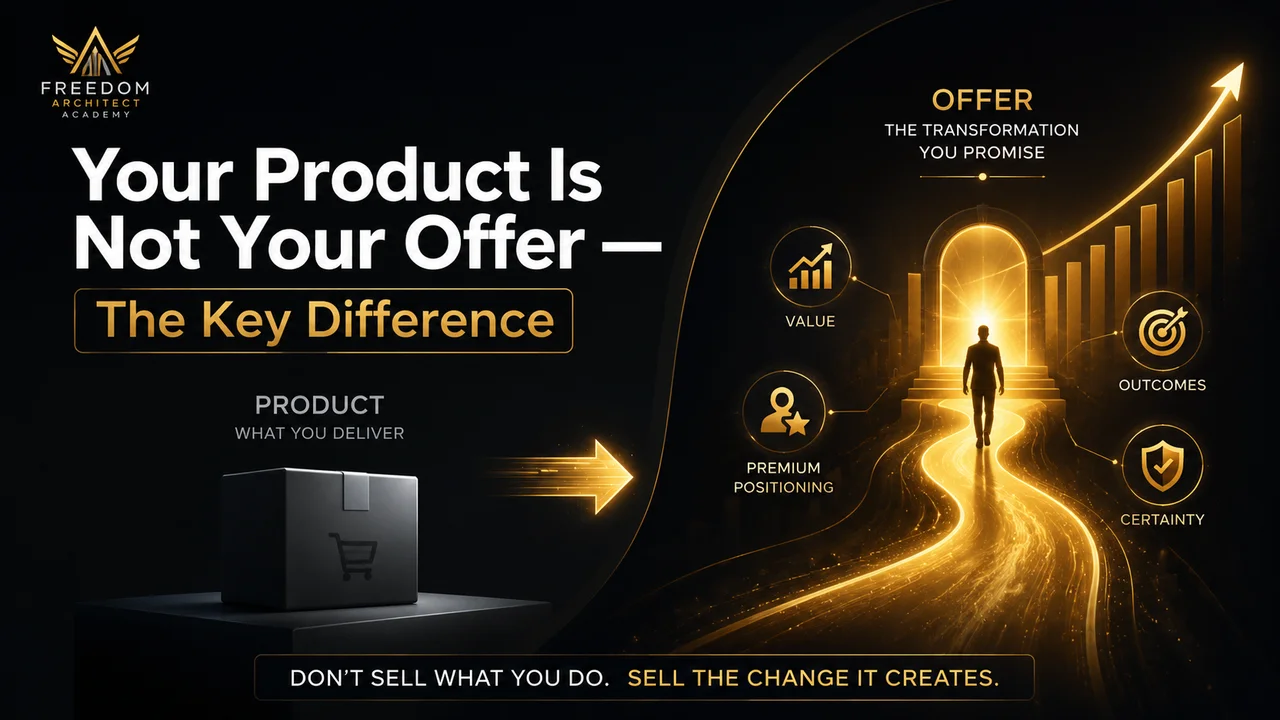
There is a confusion so common in expert businesses that it has become invisible — the confusion between a product and an offer. Most experts are selling a product. Almost none of them are selling an offer. And the difference between those two things is almost entirely what separates the consultant charging $500 for a day of their time from the one charging $10,000 for a defined transformation.
The expert with the lower price is not less skilled. They are usually equally skilled. What they lack is an offer. What they're selling is a product — and products, no matter how good they are, cannot command premium prices the way a well-engineered offer can.
TL;DR
- A product is what you deliver; an offer is the transformation you promise to a specific person.
- Products sell features, hours, and deliverables. Offers sell outcomes and certainty.
- A premium offer has four components: specific buyer, expensive problem, unique mechanism, and defined outcome.
- Most experts skip offer design entirely and go straight to delivery — which is why their prices stay low.
- The Blueprint stage of the Freedom Architecture Method is where you lock the offer that commands a premium.
Contents
- The confusion that caps your income
- What buyers actually purchase
- The four components of a premium offer
- Why your current offer is probably a product
- How to engineer an actual offer
- The price follows the offer
- FAQ
The confusion that caps your income
Here is how product thinking works: you identify what you can do, describe those capabilities, set a price (usually based on time), and offer to do the thing for clients who want it done.
It feels like selling. It has all the external features of a business. But the buyer is never buying what you're selling. The buyer is not purchasing your capabilities. They are not buying your deliverables. They are not buying your hours, your process, or your methodology.
They are buying a change in their situation. A specific future state they want to inhabit that they cannot currently reach on their own.
The product seller never offers that. They offer their expertise, their time, their process. And the buyer, unable to evaluate any of those things properly, defaults to the only comparison metric they can use: price. When you sell a product, you get compared to every other product. When you sell an offer — a specific change in a specific person's situation, delivered through a specific mechanism — you get compared to the cost of the problem remaining unsolved.
What buyers actually purchase
Think about the last premium purchase you made — not a commodity, but something you paid more than you expected and didn't regret.
What you bought was certainty. Certainty that the problem would be solved. Certainty that the person or product could deliver what they promised for your specific situation. Certainty that the investment was worth the outcome.
Premium buyers — the ones writing $5K–$10K checks for consulting engagements — are purchasing certainty above everything else. They have a real problem. It is expensive. They have probably tried to solve it before and come up short. What they want now is the highest-confidence path to a resolved situation.
An offer is the structure that provides that certainty. It names the person it's for. It states the problem being solved. It describes the mechanism that makes the solution credible. It defines the outcome the buyer can expect. That structure is what allows a buyer to say, "Yes, this is clearly for me, this is clearly the right method, and this is clearly worth the price."
Without that structure, you are asking a buyer to trust your expertise blindly — and premium buyers don't do that. They pay a premium for clarity, specificity, and a credible mechanism. The expertise is assumed. What they need is the offer.
The four components of a premium offer
Every offer that commands a genuine premium has the same four components. The words may vary. The industry may vary. The mechanism is always unique. But the structure is consistent.
1. The specific buyer. Not a demographic. A person in a specific situation, feeling a specific pain, with a specific reason to act now. "Freelancers who want to scale" is a demographic. "Experienced freelance web developers earning $80K–$120K who have hit an income ceiling, are burning out on project work, and have tried raising their rates without success" is a buyer. The more specifically you can describe the person you're for, the more that person believes the offer was built for them — because it was.
2. The expensive problem. Not a problem you can solve — the problem this buyer finds most costly, most urgent, and most personal. Expensive problems are the ones that affect income, time, relationships, or identity. They create real pressure. They motivate real spending. An offer built around an expensive problem does not need to justify its price — the buyer already knows what the problem is costing them.
3. The unique mechanism. The specific process, system, or approach that produces the outcome. This is what makes your offer yours rather than a commodity. Two consultants can promise the same outcome; the one with a named, explained mechanism is the one who gets the premium. The mechanism does not need to be literally unique — it needs to feel specific to you and credible to the buyer. It's the difference between "I help you with marketing" and "The four-stage content-to-call system I've used to generate qualified calls for expertise-based businesses."
4. The defined outcome. What specifically changes for the buyer when the engagement is complete. Not "you'll have better marketing." Not "you'll grow your business." The concrete, specific change: "You have a live funnel with a validated offer, a booked calendar, and a repeatable lead-generation system running." The more specific the outcome, the easier it is for the buyer to evaluate whether this is worth the price — and the answer is usually yes, once the outcome is clear.
Why your current offer is probably a product
If you are selling by the hour, by the day, or by the retainer month — you are selling a product. The buyer is purchasing your time and access to your expertise. They do not know what the outcome will be. You do not know what the outcome will be. The engagement runs until the time is up or the client decides to stop.
If your service description sounds like a list of deliverables — "I provide X, Y, and Z" — you are selling a product. Deliverables are features. Buyers do not get excited about features. They get excited about what the features produce.
If you have ever felt nervous quoting a price because you weren't sure it was justified, you are selling a product. Uncertainty about price almost always reflects uncertainty about the offer. When the offer is clear and the outcome is specific, pricing becomes a calculation, not a negotiation.
The fastest diagnostic: if a buyer could plausibly respond to your pitch with "sounds interesting, I'll think about it" and you'd have no obvious response, you're pitching a product. A well-built offer closes the cognitive loop — the buyer either is the person you described, facing the problem you described, wanting the outcome you described, or they are not. There is no "I'll think about it" middle ground.
How to engineer an actual offer
Start with the buyer, not the deliverable.
Who is the most specific person you serve most effectively? What is the problem they face that is most expensive, most urgent, and most personal? You are looking for the intersection of: your deepest capability, their most acute pain, and a result that is concrete enough to promise.
Once you have the buyer and the problem, work backward from the outcome. What does "solved" look like for this person, specifically? What would they say to a friend if the engagement went perfectly? That statement — in their words, not yours — is the outcome your offer must promise.
Then design the mechanism: the sequence of steps, stages, or decisions that reliably get from their current situation to that outcome. This is your process, named and explained. It does not need to be unique in the universe — it needs to be yours, documented, and credible.
Scope and price come last. Anchoring your price properly means starting from the value of the outcome, not from the hours involved. What is it worth to this specific buyer to have this problem solved? That is your ceiling. Your price should sit somewhere between "obviously worth it" and "requires real commitment."
The price follows the offer
This is the part most experts get backwards. They set a price, then try to justify it. The right sequence is: design the offer, then price what the offer is worth.
A premium offer — with a specific buyer, an expensive problem, a credible mechanism, and a defined outcome — can be priced at a premium because the buyer can evaluate it. They know who it's for (them), what problem it solves (theirs), how it works (the mechanism), and what they'll have at the end (the outcome). That evaluation is what justifies the price.
Without the offer structure, the buyer cannot evaluate. And a buyer who cannot evaluate defaults to the only thing they can evaluate: whether the price feels like too much. It almost always does.
The free training walks through the full offer engineering process — how to name the buyer, define the problem, articulate the mechanism, and set the outcome clearly enough that the price justifies itself. If you've been stuck at an income ceiling and you're not sure why, this is almost certainly the reason.
FAQ
What is the difference between an offer and a package?
A package is a product with a defined scope — a set of deliverables bundled together at a fixed price. An offer goes further: it names a specific buyer, promises a specific outcome, and delivers through a specific mechanism. The package describes what you do; the offer describes what changes for the buyer. Packages still get compared on price. Offers get evaluated on fit and certainty.
Can I have multiple offers?
Yes, but not at first. The most important constraint early on is to design and sell one offer well before expanding. Multiple offers create messaging complexity that diffuses your positioning and makes every conversation harder. Master one offer, get it to $5K–$10K, prove the mechanism, then consider what a second offer would be.
Does the mechanism need to be proprietary?
No. It needs to be specific and yours in the sense that you own how you explain and deliver it. A mechanism named and documented is proprietary enough. What makes it credible is that you can describe it clearly, explain why each step matters, and point to results it has produced. No patent required.
What if my buyers resist paying $5K–$10K?
Then one of three things is true: the problem you're solving is not expensive enough to the buyer you've chosen; the buyer you've chosen doesn't have budget; or the offer is not clear enough for the buyer to see the value. The fix is almost never to lower the price. It is to sharpen the problem, change the buyer, or clarify the outcome.
How long does offer engineering take?
The thinking — clarifying the buyer, naming the problem, designing the mechanism, articulating the outcome — typically takes several focused working sessions. The first draft of a premium offer can be done in a week of serious work. It will improve with market feedback. The goal of engineering is to get a clear, coherent offer into the world, not to perfect it in theory before you ever show it to anyone.
Ready to put this into action?
The free training shows you the entire Expertise Engine — the fastest way to turn ideas like these into a premium business.
Want help applying this to your own expertise-based business? Join the free Freedom Architect Academy community.